Ukulele versus Renaissance Guitar

How is the soprano, concert or tenor ukulele the same, yet different than a Renaissance guitar?
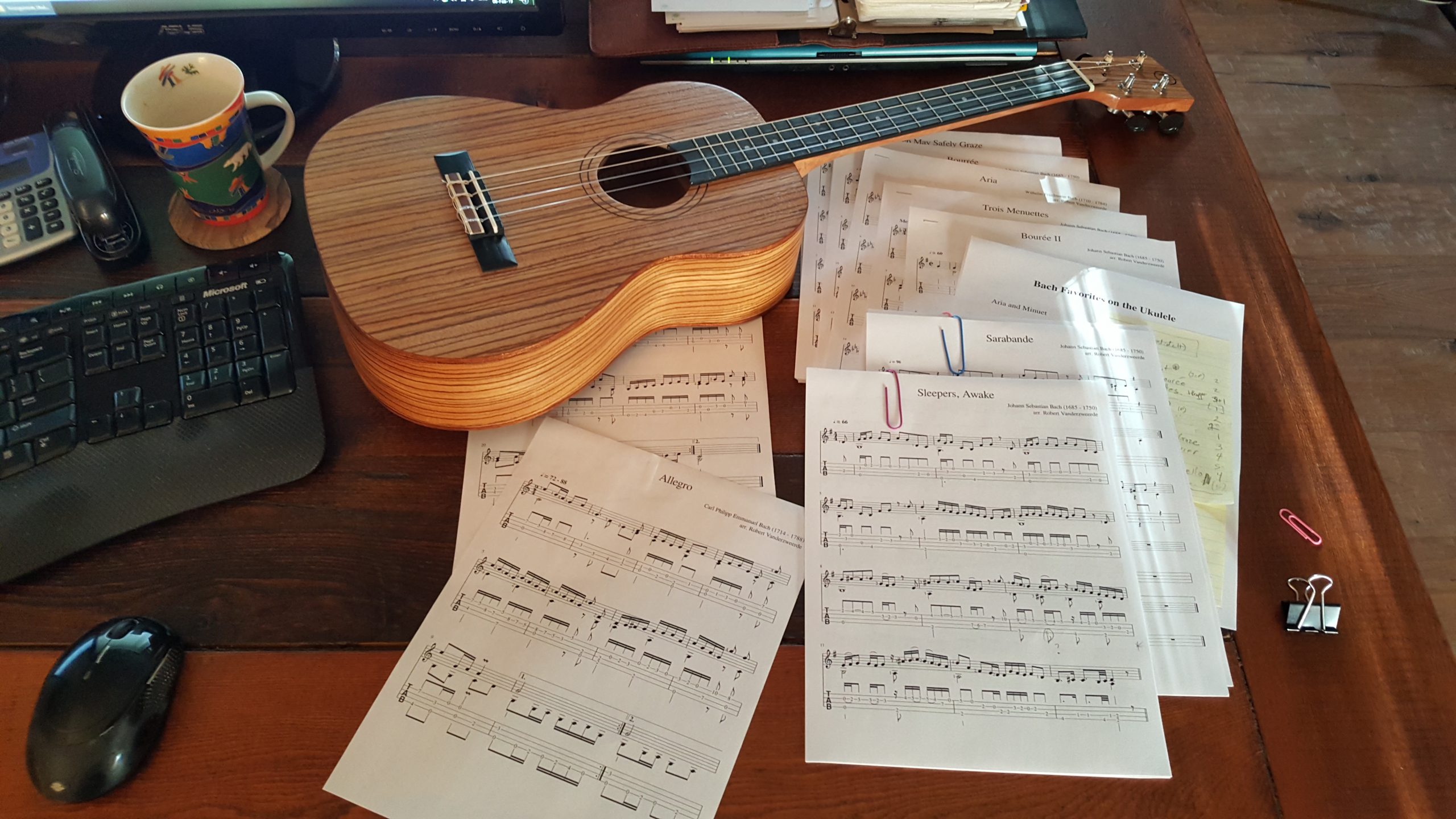
Below is a photo showing two of my instruments. The top one is a custom built replica Renaissance guitar. The lower one is a tenor ukulele made by Twisted Wood.
From my books of arrangements for ukulele …
The first documented instance of a guitar is in 1488. By the 1500’s, the Renaissance guitar was strung with 4 courses with the highest pitched single string tuned A, double E strings, double C strings and the lowest course was a split octave with a lower G and an upper G.
The modern ukulele is a direct descendent of this, although with single strings rather than courses. If the ukulele is tuned with the upper G in the fourth string, it has re-entrant tuning (the familiar “my dog has fleas” that many of us learned). A ukulele with the lower G has linear tuning.
No wonder ancient music sounds so wonderful on a ukulele.
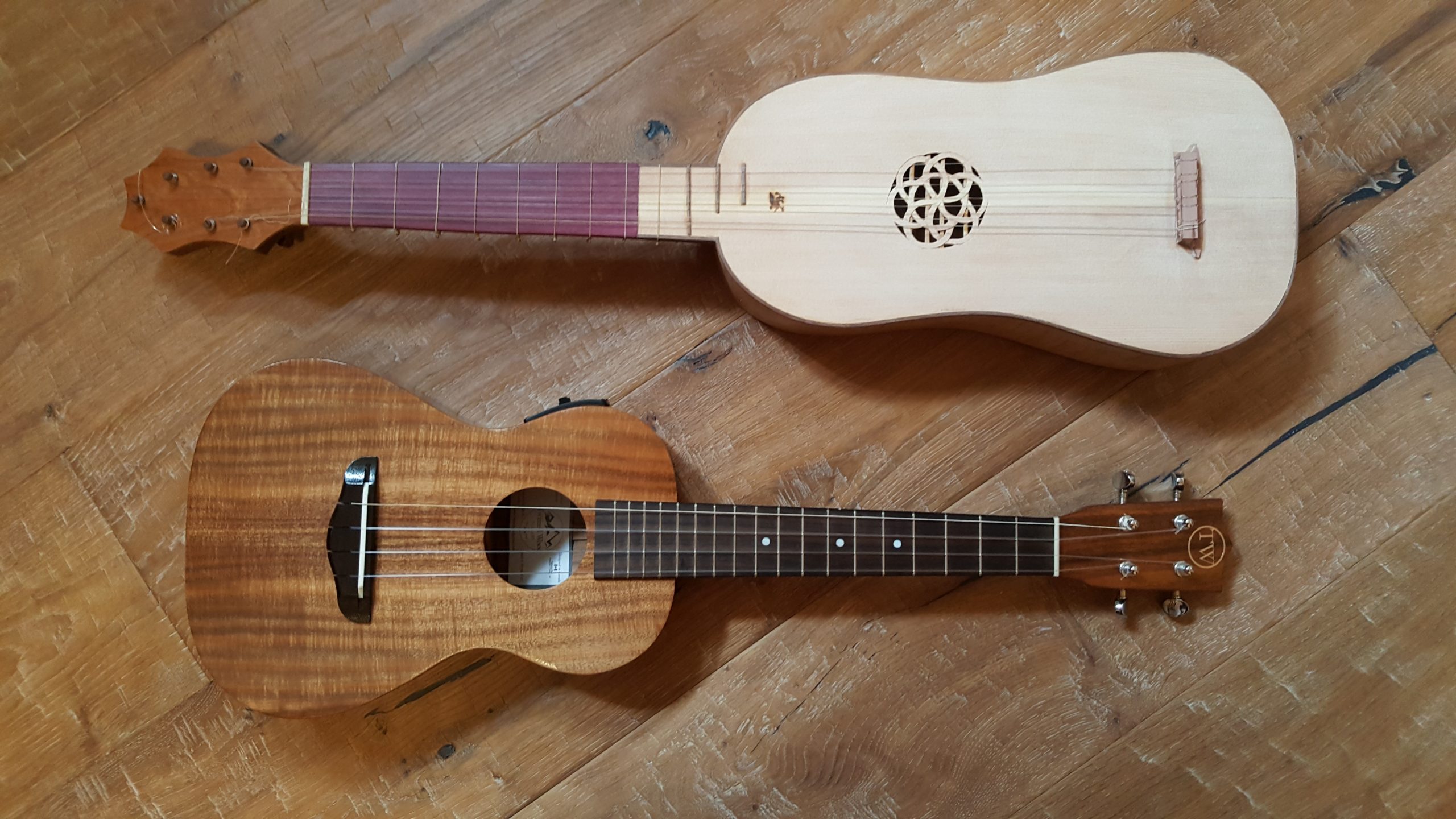
Renaissance Guitar and Ukulele

Lots of Renaissance Favorites

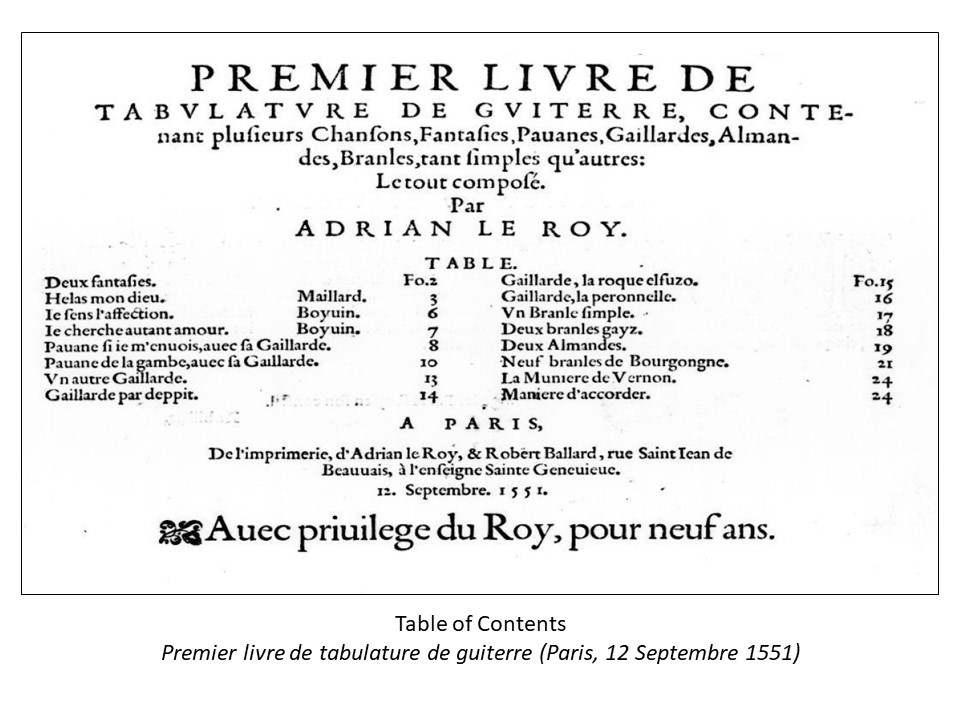
I’m going to start arranging works by Adrian Le Roy (ca 1520-1598). He was a musician and publisher and his published folios are readily available online (see the table of contents image from his first book).
 
I’ve found many transcriptions and arrangements of his music. All of them take Le Roy’s tablature and transcribe it back to guitar notation but with modern standard guitar tuning. The Renaissance guitar at the time was tuned the same as the modern ukulele (i.e. like a guitar with a capo on the 5th fret) and with double courses of strings, some tuned in octaves (I’ll post a more detailed description and pictures in a later post).
 
So, I am taking Le Roy’s tablature back to musical notation for modern ukulele with linear tuning (either soprano, concert or tenor ukulele) or Renaissance guitar.
 
I am also working on arrangements of music by Guillaume Morlaye (mid-16th century) and others for the ukulele (there are 9 original books in total in 2 series).
 
LeRoy (1551) Image - Cover
 
NOTE: The following books were published in 2020 (had lots of time due to COVID lockdowns):
  • Le Roy Favorites on the Ukulele: Book 1 (May 21)
  • Morlaye Favorites on the Ukulele: Book 1 (June 22)
  • Brayssing Favorites on the Ukulele (July 30)
  • Gorlier Favorites on the Ukulele (August 23)
  • Arcadelt Favorites on the Ukulele (September 16)
  • Le Roy Favorites on the Ukulele: Book 2 (October 6)
  • Morlaye Favorites on the Ukulele: Book 2 (October 22)
 

Researching John Dowland

I always research a piece of music and/or the composer as I arrange it and a summary of what I’ve found is included in the books I assemble. For John Dowland, there is a definitive book by Diane Poulton (you’ll notice her index number at the bottom of the piece I arranged) written in 1972 which is available for free at archive.org. I haven’t read the whole book and use it for reference. She was a an English lutenist and musicologist.
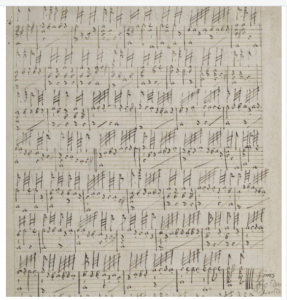
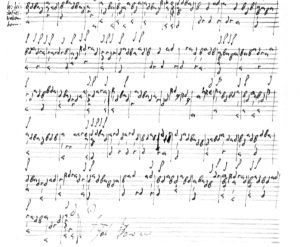
I also try to find original folios of the music, many of which are downloadable. Here are two samples of “My Lord Willoughby’s Welcome Home” from notebooks of 1610.
My Lord WIlloughby - Folio V1   My Lord WIlloughby - Folio V2

Dowland Favorites

I’m looking at more music to arrange for ukulele and have been researching Adrian Le Roy, Gregoire Brayssing, Guillaume Morlaye, Simon Gorlier, and John Dowland. I may start with some easy/intermediate pieces by Dowland (the first one being Tarleton’s Resurrection) but will tackle other composers if there is interest.

NOTE: Dowland Favorites on the Ukulele was published on April 24, 2020.

Yuletide music ready

Just finished a book of Yuletide or Christmas music (it will be available for purchase this fall). I had a lot of fun researching the origins of these pieces and some older versions don’t sound at all like our modern renditions so I included both versions and you can see for yourself. Each piece can be played as an instrumental solo or sung (a separate booklet has all the words that you can share with your friends as they sing along with you). Included in the book is a brief history of each piece with an explanation of its origins and development.

NOTE: The book was published on October 7, 2019.

Planning for Yuletide music

I know it’s hard to believe, but I’m starting planning for “The Yuletide Ukulele”. The music takes many months to research and arrange so I have to start now to be ready for next Christmas. Of course the music needs to be ancient (nothing later than18th century if possible) and there is too much of it out there to do it all. The main book will be the music, including chords, with a separate booklet with the words if there are any. Here’s a list of possible pieces and I’m looking for feedback on these please …
Coventry Carol
The boar’s head carol
In dulci jubilo
Resonent in laudibus
Riu, riu chiu
Hodie Christus nastus est
Psallite unigenite
Greensleeves (What Child Is This)
Branle de l’Offical
Joseph lieber
Es is ein Ros entsprungen
Cherry Tree carol
Viens Vite
Ciaccon in partie variata
All you that are good fellows
The old yeare now away is fled
Angels We Have Heard on High
Silent Night (actually 1818 so it’s 19th century)
The First Noel
The Holly and the Ivy
Jesus Christ the Apple Tree

An Arrangement from the Baroque

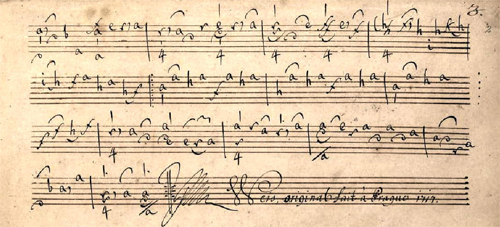
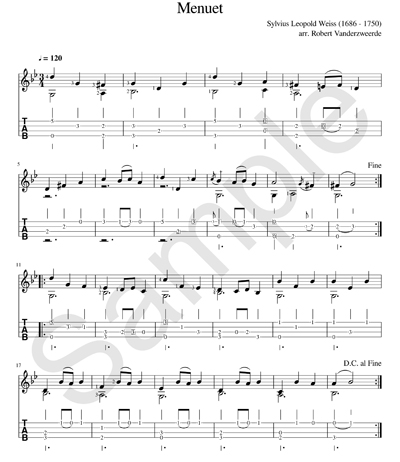
I am working on a book of Baroque pieces right now. Here’s an illustration of a score from that period (it’s not the one that I am arranging — it’s an illustration of a score from that time period) by Weiss. And here’s a sample of a Menuet by Weiss that I am including in the book using modern musical notation and tablature.

Illustration of a Baroque Score (Weiss)

Illustration of a Modern Score (Weiss)